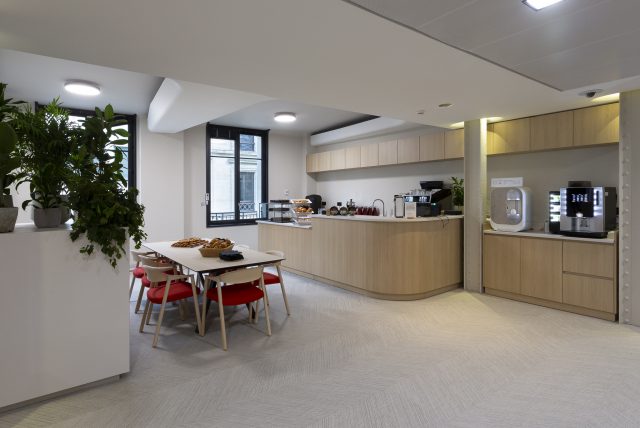
Biophilia Contributes to Well-Being at Work
At a time when companies are more aware than ever of the physical, psychological, and social effects of the work environment, it is surprising to see that biophilia is only in its infancy. Indeed, the latter brings many benefits to the workplace: reduced fatigue, increased productivity… Yet, more than 1 in 2 employees report having no natural elements in their office.
At LES BATISSEURS, we design our spaces by integrating biophilia because we believe this approach brings well-being, resources, and creativity to the office. So, how should companies integrate this design?
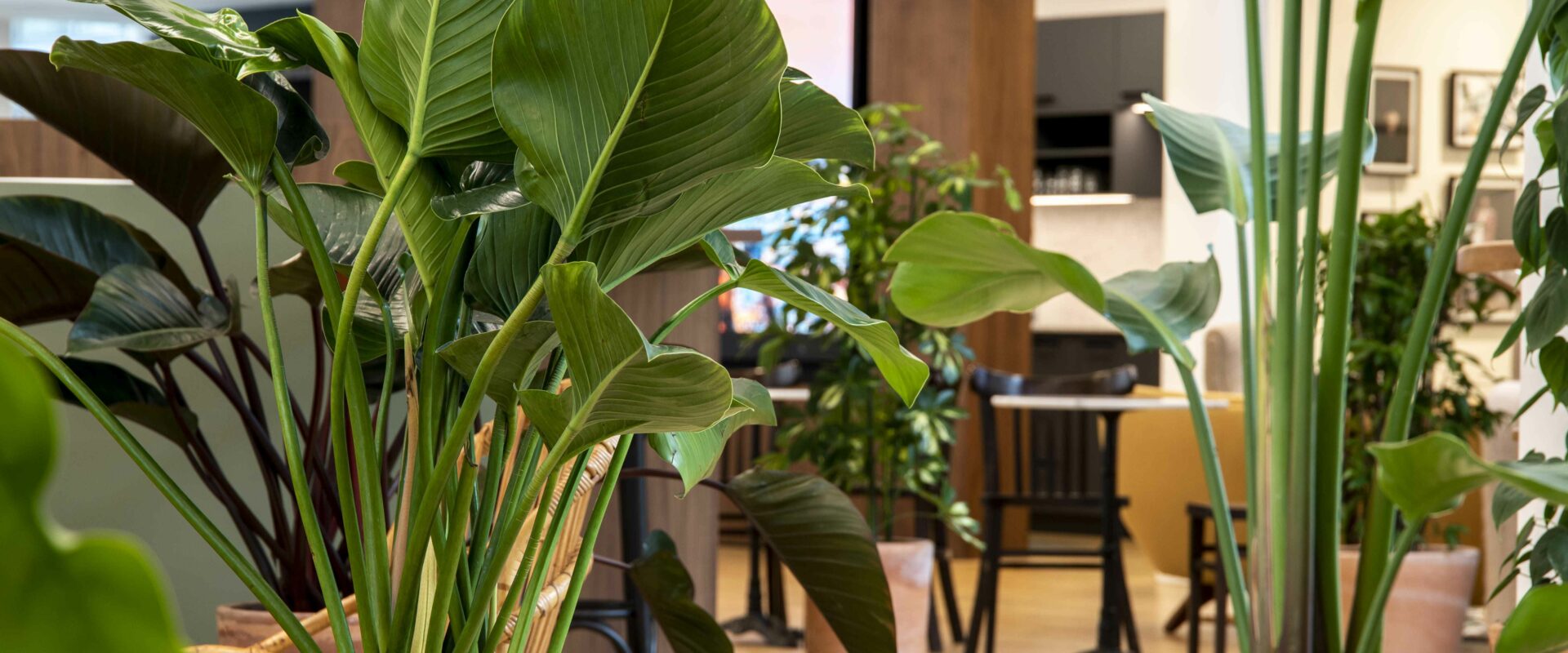
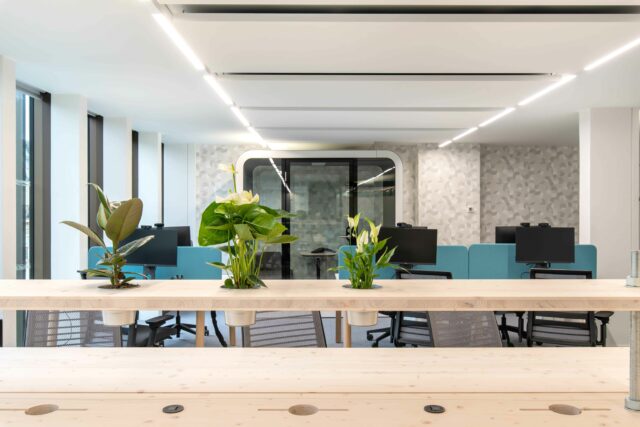
What Is Biophilia?
The word biophilia comes from the Greek “bio” (life) and the suffix “philia” (loving). This term therefore means “love of life.” More concretely, biophilia seeks to re-establish contact with nature by creating healthier living and working spaces.
This concept was initiated by the American psychoanalyst Erich Fromm in the 1960s. Later, the American biologist Edward O. Wilson further developed biophilia, which is the main theme of his book titled Biophilia.
A Vital Need to Rediscover Nature
The properties of plants can exceed all understanding, yet all studies in France and abroad are unanimous: plants offer numerous benefits for employee well-being. Unfortunately, the heavy urbanization of our lifestyles has gradually distanced us from this innate and vital bond we have with nature and living things.
As proof, according to a BVA survey for the 2020 Roch Group barometer, 81% of French people feel the need to be in more regular contact with nature. And this feeling has grown stronger since the health crisis. Indeed, the lockdown allowed urban dwellers to rediscover nature. It is therefore time for them to reconnect with it.
However, it is not necessary to have plants on every corner of a table. The need to be connected to nature can be satisfied through biophilic design (patterns, shapes, and textures). The essential thing is to have incorporations of natural elements, whether direct or symbolic, within companies. Moreover, white papers, such as “The Economics of Biophilia,” have demonstrated that using natural materials and evoking nature in a workspace increases profits and generates savings.
Biophilia Improves Employee Well-Being and Productivity
According to a 2018 Gallup Institute study, French employees were among the most disengaged in Europe. Only 6% of them claimed to be fulfilled at work. And 1 in 5 employees said they were discouraged and unhappy at work. These staggering figures must prompt companies to take action.
In this context, greenery has a role to play! In 2004, the American company Genzyme Corporation completely redesigned its headquarters by integrating natural light, transparent partitions, indoor gardens, and an atrium where chandeliers reflect sunlight. 18 months after this new layout, they found that:
- 88% of employees saw their well-being increase significantly,
- 75% stated that the building’s design increased their sense of connection with their colleagues.
Another study from Cardiff University reported the same findings. They compared the productivity of two offices, one with natural elements and the other without. The conclusion is clear: offices with natural elements recorded a 15% increase in production among employees after only three months.
These results prove that embedded elements can be a lever for action to create a positive work environment.
Resources at the Forefront
A fulfilled employee is one who will take less sick leave. And absenteeism is detrimental to profitability and impacts the morale of other employees. This issue must therefore be tackled head-on by understanding the reason for these absences. Once done, it is necessary to implement concrete actions, as employee happiness increases their productivity by 12% (University of Warwick study, UK, 2014). Also, it would reduce absenteeism by 25% (Chapman Institute study, USA, 2005).
Biophilic Design Improves Your Employer Brand
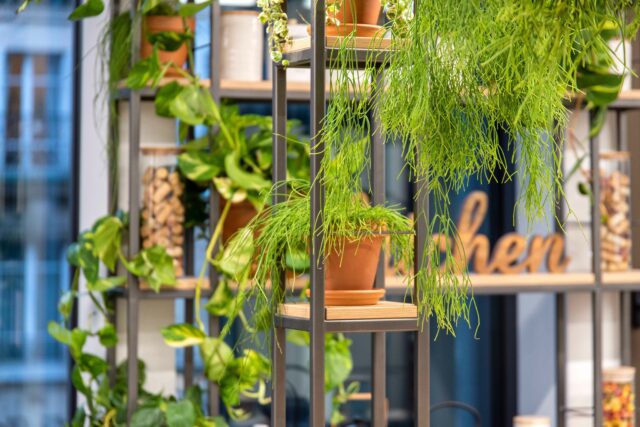
Adding greenery to premises could become an employer brand issue. As proof, according to a 2016 survey conducted by the ESSEC Real Estate and Sustainable Development Chair, 83% of students surveyed attach importance to the presence of plants in their offices and 60% to the presence of individual green spaces to maintain. Companies are forewarned: future talent pays attention to their work environment.
This will inevitably become a differentiating factor between brands and a way for companies to attract and retain their employees. The GAFAM companies have understood this well, and the layout of their premises has been designed through biophilic design.
Rethinking Office Layout
Beyond biophilic design, it is important to take the workplace itself into account. Indeed, in the EMEA region, 42% of employees report having no natural light, plants (55%), or a view of the outdoors (7%) in their work environment. These results are an opportunity to integrate the consideration of the natural environment and the provision of “green” spaces into other initiatives that are part of their health and well-being strategies.
Also, 31% of people believe they are more productive at work when they are at their own desk, in an open, partition-free space. It is therefore necessary to recognize the importance of quiet workspaces which are often essential in open spaces. We can therefore see that employee fulfillment does not only come from decorative elements but also from a good office layout, adapted to their needs.
LES BATISSEURS is an agency specializing in office design in Paris. We create custom spaces with your employees’ well-being at the heart of our thinking in order to improve the quality of life at work and the productivity of your staff.
We are at your disposal to discuss your project at contact@lesbatisseurs.paris.
You Might Also Like These Articles
Learn More
How to improve employee well-being at work?
The health crisis has reshuffled the deck for corporate work. Remote work, flexibility, office layout, individual space, eco-responsibility… the corporate world has had to adapt…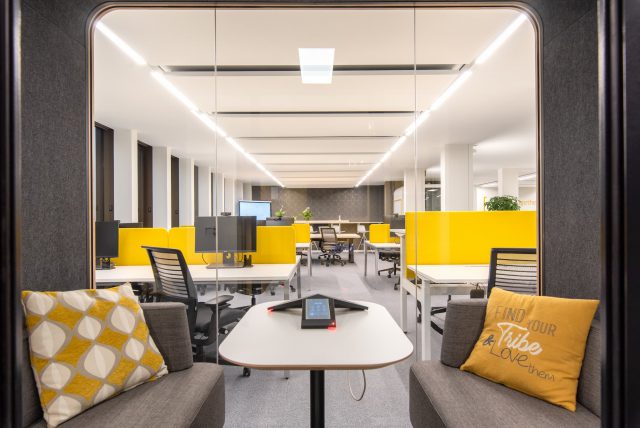
Learn More
Offices: An Essential Lever for Quality of Work Life
Quality of Work Life (QWL) now holds a central place in the modern professional world. Among the influential factors, workspaces play a crucial role. According…